ERPNext Implementation for a Distributor
TIMELINEJan 2026 - Feb 2026
ROLEERP Consultation & Implementation
TECH STACKERPNext, Frappe
OVERVIEW
Moving a growing business off spreadsheets
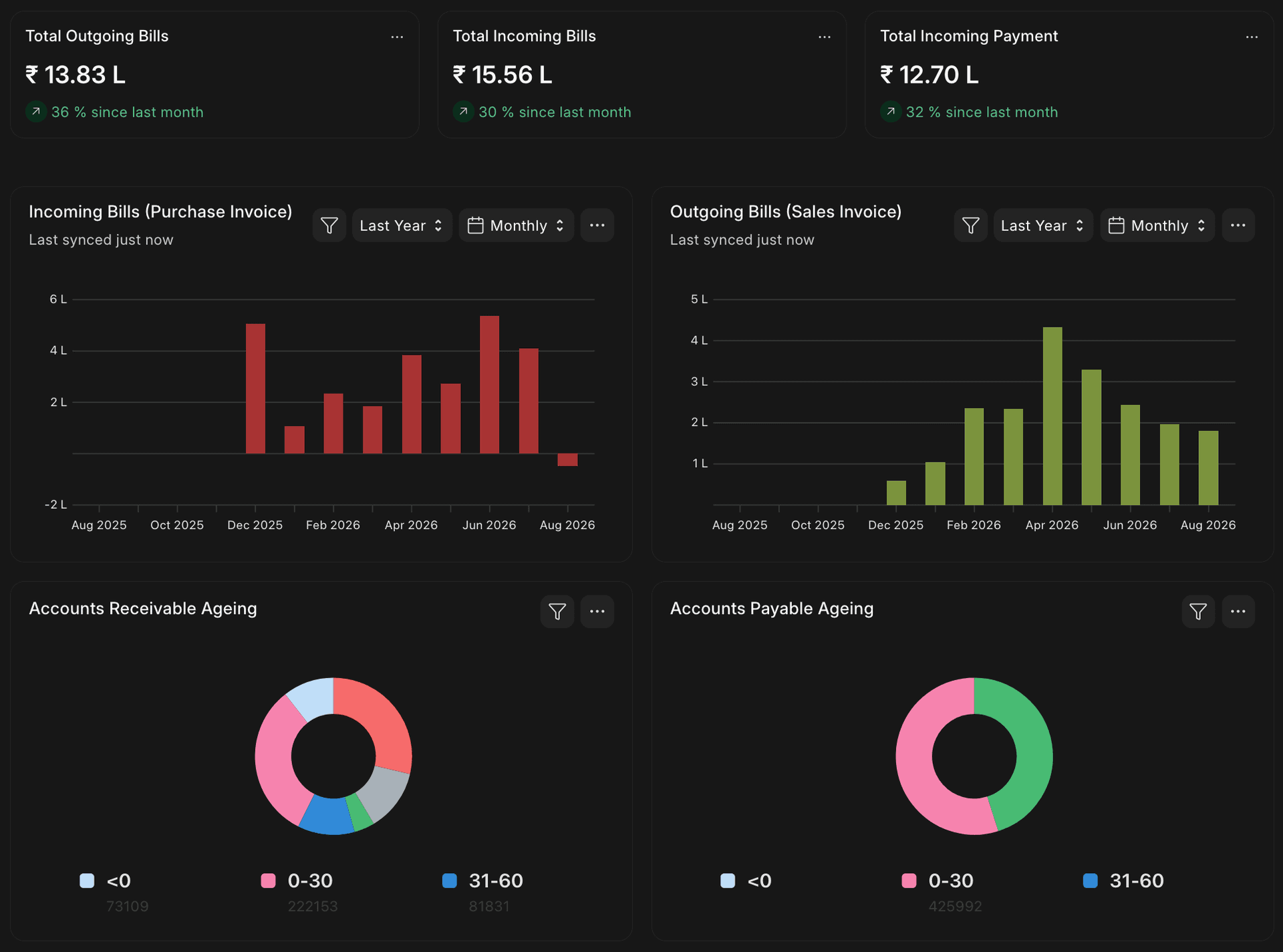
Implemented ERPNext for a distributor and stockist of an electronics accessories brand in Tamil Nadu, transitioning them from Excel-based tracking to a complete ERP system with streamlined workflows, role-based access and custom dashboards.
THE PROBLEM
Excel was breaking as the business scaled
The client managed everything in separate Excel sheets - inventory, sales, purchases, accounting, and customer records. As the business grew, this became harder to maintain. Billing was done on an old separate platform while everything else lived in spreadsheets. Entries got disconnected, reconciliation took time, values were missed in calculations, and wrong information crept in. Multiple staff working from different locations made it worse, even with shared Google Sheets.
 Different sheets of the spreadsheet workflow
The owner also had no visibility into how the business was actually doing - what was selling fast, which stock was ageing, who owed money, and what the margins looked like. The maintenance work was taking up more time than actual operations.
THE SOLUTION
An ERP that fit the business without building from scratch
I evaluated ready-made solutions in the market but nothing matched the client's needs. Building a custom ERP felt like overkill. I came across ERPNext, an open-source ERP with deep customization capabilities, and realized it was exactly what was needed.
I implemented the core modules in ERPNext and configured each one of them to match the client's workflows. The system is also accessible from both mobile and PC through a browser, so the team is no longer tied to a specific computer to create invoices, send quotations, or check outstanding balances.
HOW I BUILT IT
Learning as well as implementing
I was new to ERP systems myself. I spent time understanding ERP concepts, studying how the client's business operated, and reading ERPNext documentation to map the right workflows.
Implementation Process
After the contract was signed, I gathered requirements from the client and took time to understand their business model, current workflows and checked out how their staff work. I then came up with the redesigned workflow centered around ERPNext. I proposed the setup to the client and made necessary changes as we discussed.
- Core Modules: Purchase, Sales, Stock, Warehouse, CRM, and Accounting
- Hosting: Frappe Cloud
- Custom Reports: Revenue by product, Top margin products, Inventory by quantity and value, Fast-moving items, Customer-wise turnover and outstanding, Restock planner etc.
- Role-Based Access Control: Increasing level of permissions and access to forms & modules for Staff, Manager and Business Owner
Once the client approved the workflow, I configured the ERPNext modules as per the requirement. I made sure the forms are clean, custom fields are included, and unnecessary fields are removed and ensured the platform is simple enough to get started.
Transition
I held in-person training sessions and followed up with doubt-clearing sessions as the team got used to the new workflows. There was no major pushback because the client already wanted to move away from spreadsheets. The staff took some time to get familiar with the new tool but adapted eventually.
Data migration was straightforward since the business was relatively new and the data volume was manageable. I imported the existing records into ERPNext in the required formats.
IMPACT
From scattered sheets to a centralized system
ERPNext has been live for several months now. The client can now track stock movement, manage multi-warehouse operations, generate bills, and access business information from anywhere without being tied to a specific location or a device.
The client mentioned the new system is saving them several hours per week across the team and that they have noticed significant improvements in the following areas:
- Reduced manual work - No more duplicates or manual errors, accurate accounting and reconciliation
- Right level of access - With RBAC, each person sees only what they are supposed to
- Better business visibility - Customized dashboards to make data-driven decisions
- Scalable operations - The system does not become a chokehold as users and data grow
REFLECTION
Problem-solving across unfamiliar domains
I had no prior ERP experience, but by understanding the business first and mapping the right technology, I was able to implement something that actually made daily operations easier for the client.
This project reinforced my belief that I can take on a problem in an unfamiliar domain, learn the tools, and deliver a solution that satisfies the client.